Navigating Orthodontic Insurance Plans in the USA: A Complete 2024 Guide
Have you heard that Braces are as expensive as $3000 to $7000 average in the United States (and even more than 6000 in most cases) to cover an entire adult? This is a huge cost that serves as a major drawback to the cost of accessing the necessary orthodontic services by many American families. Having a difficult time in understanding the confusing world of orthodontic insurance policies in the USA, you are not alone.
A survey of consumers commissioned by the National Association of Dental Plans in 2024 revealed that more than 60 percent of consumers consider dental insurance benefits to be more difficult than medical insurance to understand. The following guide will help to eliminate such confusion and equip you with the professional information and strategic thinking that you need to navigate the marketplace to maximize your benefits and make financially wise decisions in regard to the oral health of yourself or your child.
We will unravel the magic behind the key words, a comparison of the types of plans and a clear action plan of assessing your options. Be it because you are in need of orthodontic insurance cover as an adult or even as part of a plan to cover your children, this all-inclusive guide will enable you to settle on the cover that is likely to offer you the best services and prevent any expensive surprises.
Understanding the Basics: How Orthodontic Insurance Differs from Dental Insurance
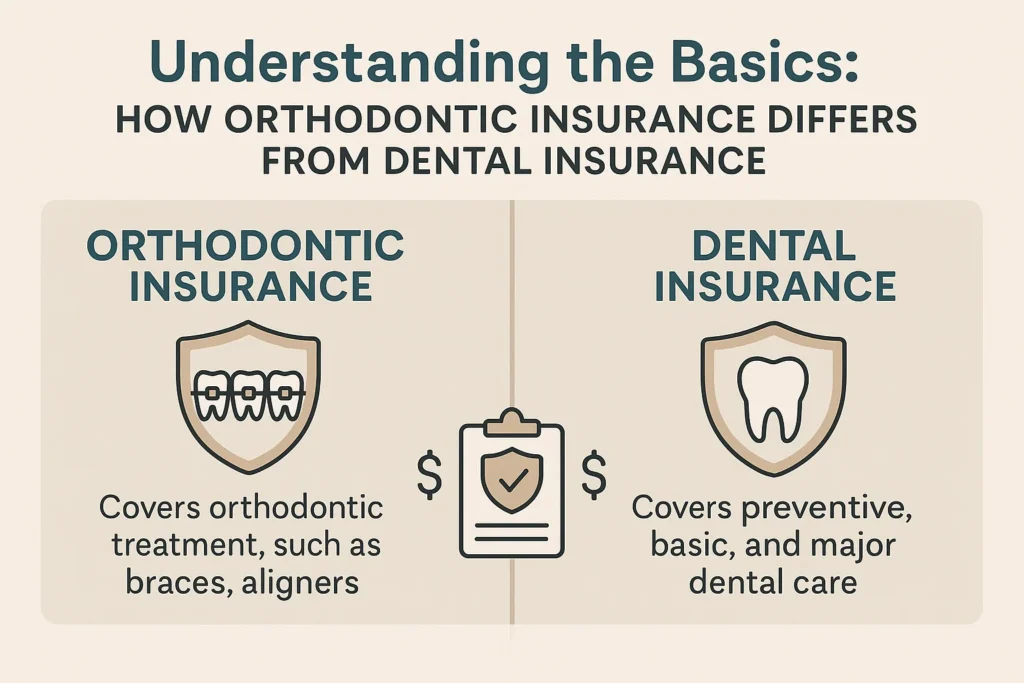
To begin with it is important to appreciate the fact that most dental insurance plans do not include orthodontic in their coverage package. Whereas general dental insurance is the category that is usually geared towards prophylaxis (cleanings, check ups) and basic dentistry (fills, extractions), in cases where it is medically imperative, orthodontics is usually treated as a specialty or optional service.


Most standard dental insurance plans that do include orthodontics do so with significant caveats:
- Age restrictions: The coverage is often fully biased towards children and adolescents of the age of 18 or 19. It is harder and more costly to locate sound orthodontic insurance plans among adults.
- Waiting Periods: Unlike preventive care, in almost all cases orthodontic benefits require a waiting period which is typically 6 to 12 months after joining the plan. This eliminates individuals who want to join when they are in urgent need of treatment.
- Lifetime Maximums: This is the number that is most important to identify. Rather than annual maximum, orthodontic coverage typically has a separate, one-time orthodontic insurance cost lifetime maximum per person. It is a set amount of money (e.g., $1,000, $1,500, $2,000) which the insurance will be able to pay out with orthodontic treatment, no matter how much the treatment will cost or take.
Expert Insight: “Consumers often mistake having ‘dental insurance’ for having ‘orthodontic coverage.’ The first question you must ask your insurer is, ‘Does this plan include orthodontic benefits?’ and then immediately follow up with, ‘What is the lifetime maximum and what is the waiting period?’ These two factors will dictate your financial responsibility more than anything else,” advises Sarah Jenkins, a certified health insurance navigator.
Types of Plans: PPOs, DHMOs, and Discount Plans
When searching for insurance plans that cover orthodontics, you’ll primarily encounter three structures. Understanding the difference is key to choosing the right plan for your needs.
1. Dental PPO (Preferred Provider Organization)
This is the most common type of plan offering orthodontic coverage dental insurance.
How it works: You can select a pool of preferred dentists and orthodontists that have entered into negotiations with the insurance company. You are able to see out-of-network providers, but you will be paying a greater percentage cost.
Pros: Greater flexibility in choosing a provider; no need for a primary dentist referral.
Cons: Typically higher premiums and deductibles than DHMOs.
2. Dental HMO (DHMO – Dental Health Maintenance Organization)
Also known as a capitation plan, a DHMO is often more affordable but more restrictive.
How it works: You will have to select a primary dentist who is within the network of the plan and you will require a referral to an orthodontist by the dentist. There is a certain amount of copayment you make on certain services.
Pros: Very low premiums and no deductibles; predictable copays for orthodontic treatment.
Cons: Extremely limited choice of providers; no coverage whatsoever for out-of-network care.
3. Dental Discount Plans
These are not insurance, but they are often marketed alongside it.
How it works: You make a yearly membership fee to be able to access a network of providers willing to offer you discount on their services, including orthodontics.
Pros: No waiting periods; immediate savings; low annual cost.
Cons: Not insurance, so you are responsible for 100% of the discounted fee. The savings can be significant but are not a guaranteed percentage.
Comparison Table: Orthodontic Plan Structures
| Feature | Dental PPO | Dental HMO (DHMO) | Discount Plan |
|---|---|---|---|
| Provider Choice | Large network; can go out-of-network for higher cost | Very limited network; must stay in-network | Participating providers only |
| Cost Structure | Premium, Deductible, Coinsurance, Lifetime Max | Low Premium, Copayments | Annual Membership Fee + Discounted Rate |
| Waiting Period | Common (6-12 months) | Sometimes waived or shorter | None |
| Best For | Flexibility and choice of orthodontist | Predictable, budget-friendly costs | Those without insurance seeking immediate discounts |
Maximizing Your Benefits: A Step-by-Step Action Plan
Simply having a plan isn’t enough. To truly maximize your orthodontic insurance for adults or children, you need a strategic approach.
- Get an estimate of Pre-Treatment: Prior to any treatment, ask your orthodontist to present an elaborate treatment plan to the insurance company. They will will give back a pre-determination of benefits that spells out what they will cover and what you will owe. This will save unwanted bills in the future.
- Having Your Lifetime Maximum: In the event that your lifetime max is 1,500, and your treatment is 6,000, your insurance will cover 1,500 and you are expected to pay the remaining 4,500. This is something to include in your budgeting.
- Request Payment Plan: The vast majority of orthodontic offices have in-house payment plans where they can finance your out of pocket cost interest-free over the period of treatment (e.g. 24 months). This can be easier to handle as compared to paying in lump sum.
- Coordinates Benefits on Dependents: In the event that the parents have dental coverage in which they can cover orthodontics on a kid, they might be in a position to coordinate benefits. This does not provide additional coverage although, the secondary insurance can contribute to the balance of the amount paid after the primary insurance has been paid, which could reduce your overall out-of-pocket amount.
- Start Your Treatment: Awaiting times: In case you are changing jobs or plans, you need to know waiting times. Arrange the commencement of treatment following the satisfactory waiting period in order to have benefits.
Top Providers and Plan Options in the USA
While many companies offer dental insurance plans with orthodontics, a few consistently rank highly for their coverage and network size.
1. Delta Dental
Delta Dental as one of the largest networks in the country provides an assortment of bonds between PPO and HMO plans. Their orthodontic insurance cover of kids is very healthy and most of their PPO covers also cover adults but with a less lifetime limit.
2. Cigna
The dental PPO plans of Cigna tend to cover orthodontics of children and adults. They have a reputation of being used as simple online devices to locate the in-network orthodontists and also estimate the costs.
3. MetLife
The TakeAlong dental plans offered by MetLife are known due to the wide network. They have a range of PPO plans as well as their orthodontic dental insurance plans clearly stipulate lifetime limits and waiting terms at the outset.
4. Guardian
Guardian is also a service that has been highly suggested based on its good customer service and broad PPO plans including orthodontics. They are a good option to those who need adult orthodontics insurance plans.
Alternatives to Traditional Insurance: FSA, HSA, and Medical Credit
If your insurance benefits are low or nonexistent, consider these financial tools to manage the orthodontic insurance cost:
- FSA (Flexible Spending Account): You can use pre-taxed money that you save in your paycheck to cover the orthodontic bills related to the eligible expenses. You have to spend the funds after the plan year (with minor grace period or roll over concession, according to the plan). Pro Tip: You can spend all your FSA election one on the first day of your plan year, although you may not have had it all deduced yet out of your paychecks. This will enable you to receive a huge initial down payment as reimbursement.
- HSA (Health Savings Account): This is offered, in combination with a High-Deductible Health Plan (HDHP). It is pre-tax, and the funds roll over from year to year, and the balance may be invested. It is a great method of orthodontic treatment, which can be saved and kept tax-free.
CareCredit: A special purpose medical credit card which has promotional short-term financing plans, usually with no interest on provided there is full payment within a given time (e.g., 6, 12 or 18 months).
Employer Dental Insurance USA: Top Plans for Your Employee Benefits
Frequently Asked Questions (FAQ)
Does Medicare or Medicaid cover orthodontics?
Medicare Original Medicare (Parts A and B) does not provide holism dental treatment; Orthodontics is not included. Medical imaging Dental dental plans under some Medicare Advantage (Part C) plans might cover dental benefits, but orthodontic is uncommon and is usually restricted to medically necessary cases.
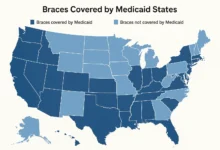
Medicaid: The orthodontics coverage is incredibly different across the states. In the vast majority of cases, the orthodontic treatment of children will be covered by the Medicaid only in case it is considered medically necessary (e.g., a cleft palate needs to be corrected, it severely impairs the functioning). Cosmetic alignment is hardly discussed. You will need to verify with your state Medicaid program to determine exact information about orthodontic insurance plans available on CHIP and Medicaid.
Can I get orthodontic insurance without a waiting period?
An orthodontic waiting period is very hard to come by in an orthodontic insurance plan. Your three primary choices are: 1) enrolling in a plan through a new job where possibly the waiting period is waived (unusual), 2) buying a DHMO plan where sometimes the wait is shorter or 3) a dental discount plan, which offers instant discount but is not insurance.
Invisalign: is Invisalign covered by insurance?
The majority of orthodontics-covering plans will cover Invisalign clear aligners in the same way that they cover traditional braces. The two types of treatment are normally not differentiated by the insurance company; it is all orthodontics. You will have a benefit (the lifetime maximum) equal. Nonetheless, due to the high cost of Invisalign, it is likely that your out-of-pocket payment will be greater than that of the metal braces.
Should you purchase insurance and only cover orthodontics?
You need to do the math. Divide the annual premium cost times the waiting period (i.e. 12 months x 30/month = 360). Next deduct that sum to the lifetime maximum of the plan (e.g., $1,500 -360 =1,140). Your possible net benefit is this 1,140. Assuming that your out of pocket expense without insurance is lower than this net benefit plus your premium payments, then it might not be worth it. In many cases, an HSA/FSA or discount plan prove to be cheaper in terms of an adult.
What is the meaning of medically necessary orthodontics?
This is the treatment needed to work on a functioning deficiency or a health issue such as the inability to chew or talk, jaw pain or TMJ disorders, the repair of a cleft lip/palate, or the correction of a skeletal discrepancy that influences well-being. Cosmetic enhancement per se, is not medically necessary. Certain plans would only offer cover in cases where it is medically necessary.
Conclusion: Your Path to Affordable Orthodontic Care
To make your way in the orthodontic insurance plans in the USA, it is necessary to thoroughly research the topic and to have a clear image of your family and financial issues. The lessons learned are that you should always check the cover with the insurer, get an estimate of the pre-treatment and to realise the importance of the lifetime maximum and waiting periods. Although insurance is a potentially helpful means of financial help, it will hardly be able to fully cover the cost of treatment.
The best next step is to make yourself an educated consumer. Prior to making your appointment with an orthodontist, pick up your phone, dial your insurance company (or prospective one) and find out the following answers to the following three questions: 1) Do you cover orthodontics? 2) What is the lifetime limit? 3) What is the wait period of orthodontic services? Having this information your hand, you will feel confident in what your treatment options are and what financial path will be taken to lead you to a healthier and more confident smile.

